Delaware-based company Trexo Innovation has announced the Trexo Slider, what it claims is the world’s most compact camera slider designed with modern-day content creators in mind.
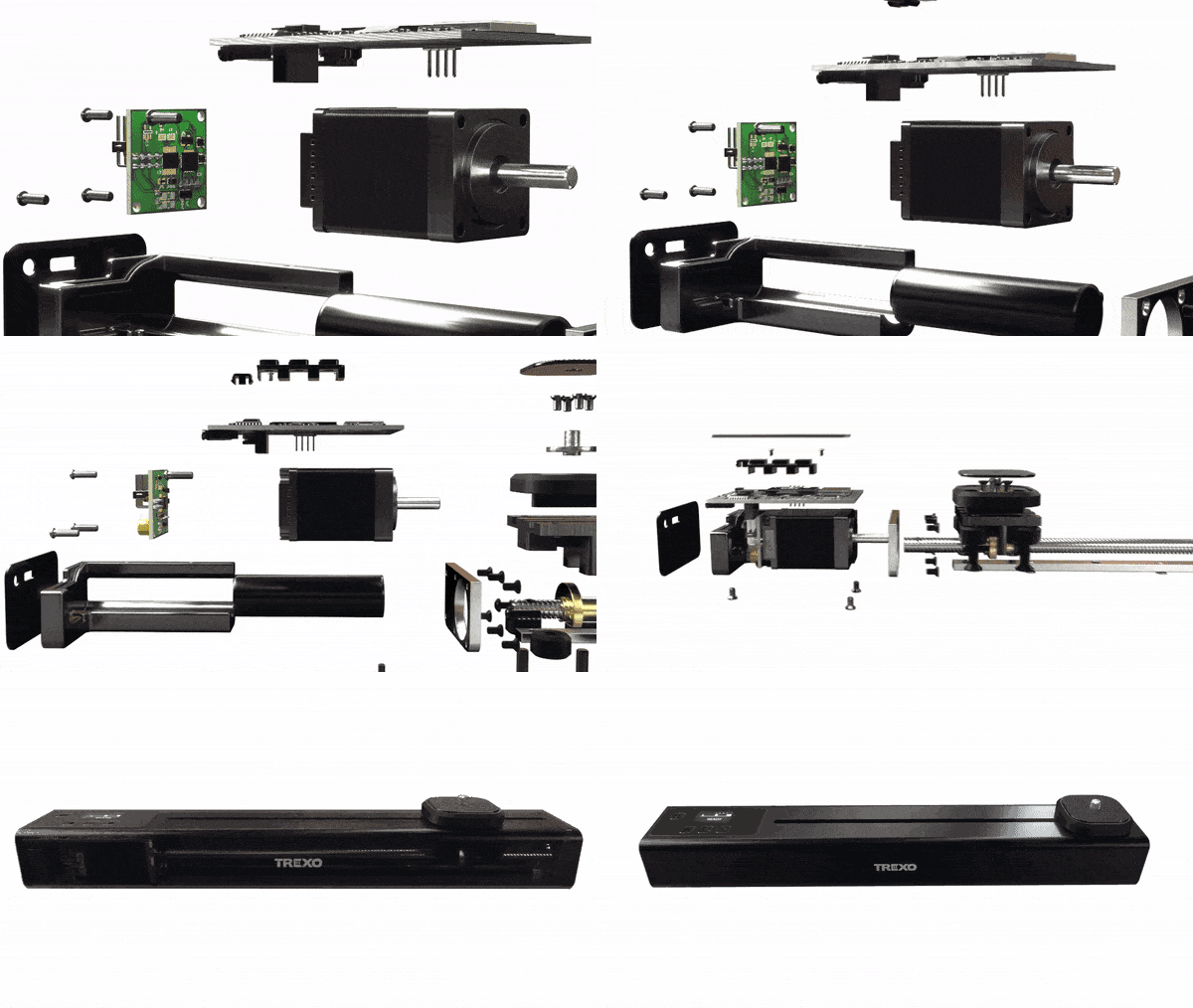
Unlike many other sliders on the market, Trexo Slider does not use a belt-operated system. Instead, the Trexo Slider uses a lead screw to operate. Trexo claims this should help limit the causes responsible for problems such as vibrations, jitters, bumps, and noise.
“Trexo Slider does not include a gearbox and belt mechanism,” the company says. “Our unique leadscrew design eliminates all the issues of belt-operated sliders such as jitters, jumps, and vibrations and allows you to have precise speeds as slow as 0.001mm/second and as fast as 3cm/second.”
Additionally, the company says that this lead screw design is highly energy-efficient and allows it to operate for up to six hours with the onboard battery (3,250 mAh). The Trexo Slider can also be powered via the included USB-C cable.
The Trexo Slider can be operated both by the Trexo Motion App and via the onboard menu. Users can program movements by hand, which can then be saved and used again as presets or shared with others also using the Trexo Motion App.
Outside of the programmable moves, the slider also has the standard loop mode (bounces back and forth at a given speed) and a mode designed to work at an incline. All the modes support speed adjustments either via the onboard menu or through the app.
As mentioned, the slider is very compact. Its has a footprint of 12.9 x 1.9 x 2.2 inches, weighs 1.9 pounds total, and its operating length is a scant eight inches (20 centimeters). Despite its small size, it can successfully operate horizontally with a load of up to 11 pounds, inclined at a 22.5-degree angle with a load of 5.5 pounds, operate vertically with a load of 3.3 pounds, and descend vertically with a load of 5.5 pounds.
Trexo Slider in CNC Machined aluminum with stainless steel parts and weights 870grams | 1.9lbs and can carry up to 5kg | 11lbs.
With the upcoming add-ons, Trexo Slider can be upgraded to a 3-axis motion control system.
The Trexo Slider is available to back on Kickstarter starting at $295, which includes the slider, the charging cable, and access to the motion app. Higher-priced backing options include accessories like a flexible arm and ball head as well as multiple Trexo Sliders.
Disclaimer: Make sure you do your own research into any crowdfunding project you’re considering backing. While we aim to only share legitimate and trustworthy campaigns, there’s always a real chance that you can lose your money when backing any crowdfunded project.
Google is rolling out a new safety section in the Play Store designed to show users more detail about the data apps collect and how it is used, the company has announced. The section will be gradually rolling out for users over the coming weeks, and app developers have until July 20th to add the information to their listings — so the section may not immediately appear for everyone. The initiative was first announced last year.
According to Google, the section is an attempt to give users more information and context. It’ll list the data each developer is collecting, if they share it, and their security practices (such as whether they encrypt the data while in transit). There will also be information on whether a developer follows Google Play’s Families Policy as well as if their security practices have received third-party validation.
More information on what developers need to disclose can be found on this support page. According to the page, misrepresenting an app’s data collection practices or otherwise failing to fill out this section could mean that an app’s updates are blocked, and it may even be removed from the Play Store. “Even developers with apps that do not collect any user data are required to complete this form and provide a link to their privacy policy,” the page says.
The Play Store’s newfound transparency follows the launch of a similar feature on Apple’s App Store in late 2020. But Google’s support page notes that its safety section is not necessarily a one-to-one counterpart to Apple’s, so developers cannot expect to provide exactly the same information to both. “The taxonomy and framework of the Data safety section on Google Play may differ materially from those used in other app stores,” the page reads.
The initiative is part of Google’s ongoing attempts to ensure that Play Store apps respect user privacy. Earlier this month it announced plans to restrict the availability of outdated apps on the Play Store in an attempt to ensure that those available for download are using Android’s latest privacy and security features.
After weeks of rumours and a little tease from Niantic itself yesterday, the company has announced that the oft-criticised Mega Evolution system in Pokémon GO is finally being revamped.
The flashy teaser above hints at more effortless ways to use Mega Evolution on your Pokémon. There's also a silhouetted 'mon within, almost definitely a Mega Kangaskhan, who was datamined last month.
Fans have long been disappointed with how Mega Evolutions have been implemented into the AR game, but now Mega Raids are being made easier, and once you've Mega-Evolved a Pokémon once using Mega Energy, you can evolve them again free of charge! These are the highlights of this update, which is being rolled out across the world gradually:
Highlights
- Most Mega Raids will be easier. You can now take them on with fewer people!
- You’ll be able to Mega Evolve your Pokémon from raid and battle prep screens.
- Pokémon you have Mega Evolved before will now have an additional visual effect added to their information page to commemorate this momentous achievement.
- We’re implementing Mega Levels and changing how Mega Energy is used.
The star of this update is Mega Levels, a brand new system that changes how Mega Energy is used within the game. Essentially, every time you Mega Evolve a Pokémon, their Mega Level increases, and you get more bonuses as their Mega Level goes up.
Niantic has made some changes to existing systems within the game to be more compatible with this, but also brought in additional boons:
Existing bonuses - Increased Candy when you catch Pokémon that are the same type as your Mega-Evolved Pokémon.
- While attacking with a Mega-Evolved Pokémon in a Raid Battle or a Gym battle, the attacks of other Trainers’ Pokémon challenging that same raid or Gym will deal more damage. Their Pokémon’s attacks will deal even more damage if the attack is the same type as your Mega-Evolved Pokémon.
New bonuses -Increased chance of earning Candy XL when you catch Pokémon that are the same type as your Mega-Evolved Pokémon.
- Increased XP for catching Pokémon that are the same type as your Mega-Evolved Pokémon.
- A Pokémon’s rest period decreases as its Mega Level increases.
It definitely seems like a significant improvement on what's become a popular gimmick in the main series, so it's fantastic to see it get some proper love in the mobile game.
Even though Mega Evolution is easier, the one-time cost does put in some understandable restrictions — otherwise, you'll be popping out Mega Blastoise at every opportunity! Once you Mega Evolve a Pokémon, they will become fatigued. And until they are fully rested, they cannot Mega Evolve again.
MORE MEGA MOMENTS: A one-time cost to Mega Evolve
With this update, after you Mega Evolve a Pokémon for the first time, you’ll be able to Mega Evolve that same Pokémon again without using Mega Energy!
- After Mega Evolving, your Pokémon will be fatigued and need time before it can Mega Evolve again. Once this rest period is over, that Pokémon can Mega Evolve again without using Mega Energy.
- You can use Mega Energy to decrease a Pokémon’s rest period. The Mega Energy required to Mega Evolve a Pokémon will decrease as the Pokémon’s rest period becomes shorter.
The latest Dev Diaries entry from Niantic goes over these changes in much more detail. These are all welcome updates to the game, and we hope this brings a lot more people out to do Mega Raids and Mega Evolve their Pokemon.
The update is out now in Australia and New Zealand and will be rolled out gradually to the rest of the world in the coming weeks.
How do you feel about the update? If you're in Australia and New Zealand have you had a chance to try it out? Let us know.
The latest lark in culinary cuisine is artificial meat substitutes. However, the newest addition to the line oflab-grown foodsmight take you by surprise—because it’s ‘lion meat’. Yes, you read that right folks. It seems that the predators have caught the attention of the fine dining industry. If the concept oftiger tacosinterests you, then keep reading, because they could soon be available at your favourite restaurants in the UK.
From a list including lions, tigers and bears (oh my, indeed), at least two of these animals could very well end up taking over menus in restaurants. If the pitched products manage to pass regulatory checks, that is. A menagerie of select choices of meat for dishes we all know and love—think succulent tiger steaks and exotic zebra sushi rolls—will also accompany the possible sale of lab-grown lion meat in the UK. Though there’s one thing we feel the need to clarify: the meats in questiondo notcome from the animals themselves, instead they’re from the cosy confines of laboratories that create them artificially.
The idea is the brainchild of tech startup Primeval Foods. The meat itself is “cultivated” from the self-declared “future of food” company, and though it is climate-friendly, it raises a few eyebrows—along with truckloads of other questions—as to where our meat comes from and whether we should even be eating it at all.
The Independent detailed that Primeval Foods’ goal is to get its meats into “Michelin-starred restaurants in London,” with even bigger plans to “expand on a larger scale, even to local supermarkets.” So mock meats could end up on our shelves, huh? Let’s find out more about them before our local supermarkets start stockpiling these artificial creations.
What is this so-called “cultivated meat” everyone is speaking of? Well, it is a production method that allows companies to make food from any species—you know, minus all the animal slaughter. How, you ask? The answer lies in animal cells, which are directly harvested and allow these companies to replicate “the sensory and nutritional profiles of conventional meat,” according to the Independent. Instead of the bloodshed, cultivated meat producers grow the necessary animal cells directly, which gives them the chance to replicate all the nutritional profiles and the ever so sought-after sensory experiences of eating the real deal.
This concept helps us all dodge the unnecessary process, which is considered barbaric by many, of raising animals for their eventual slaughter. Considered as a more sustainable practice of meat making, these lab-grown creations also aid the effort to conserve our world’s resources by maintaining land and water, “preserving habitat, reducing greenhouse gas emissions, and preventing manure pollution and antibiotic overuse,” as the Independent further noted.
However, there are some caveats to this new creation. For one, we don’t know much about the scalability of this fake meat business. As the Independent pointed out, “cultivated meat is not yet produced on an industrial scale.” Along with the “relative uncertainty” that it could actually benefit the planet preservation-wise, in February 2022, the Financial Times reported a “slump” in plant-based sales when company Beyond Meat’s stock plummeted by 11 per cent. The Independent also outlined that, within the last three months of 2021, the company’s losses have amounted to around $80.4 million—more than three times that of the previous year.
On the flip side, scientists do seem to agree that the overall environmental impacts of cultured meat production would be considerably marginal compared to the conventionally-produced ones that is today’s standard. A study, published byACS Publicationsin 2011, observed the impacts of cultivated meat and went on to state that its production uses approximately anywhere from seven to 45 per cent less energy than what is used in the production of European meat. The study also concluded that greenhouse gas emissions were 78 to 96 per cent lower, and land usage also managed to get cut down by 99 per cent. Heck, even water usage went down by 82 to 96 per cent. Lab-grown: 1, homegrown: 0.
Primeval Foods and its advocates certainly agree. “People are constantly seeking to discover new foods, new restaurants, new culinary experiences, but the traditional species have reached their limitation on meeting this demand,” said Yilmaz Bora, managing partner for Ace Ventures—which is the London-based venture studio that created Primeval Foods. “It has to go beyond the current beef, chicken, and pork dishes, and it has to come without the expense of nature,” he added.
Furthermore, the company has big plans to host taste testings in the coming months “to give the world a taste of what the next chapter of food would look like,” Bora enthusiastically claimed.
The company thinks its meat could rise above the hit that the food industry has taken in recent years—believing that now is the time to “double down on innovative ideas,” the Independent reported. Not only are the meats in question climate friendly, but Primeval Foods hopes these ‘exotic’ alternatives will also prompt people to explore novel culinary experiences.
So why not be a little adventurous and try a lion burger on your next meal out?
Popular Reads
Lab-grown lion meat could soon be served at your favourite restaurants in the UK
SAVE $219: If you can't decide between a new tablet or laptop, the Microsoft Surface Pro 7 offers a powerful hybrid experience. And as of April 25, Walmart has it on sale for only $679.99, 24% off its usual cost and the lowest price we've seen on this particular configuration.
Laptops and tablets are great on their own, but sometimes it's more productive to have both — at once. That's where the hybrid laptop or 2-in-1 laptop comes in handy. It's a device that seamlessly switches between a tablet and a laptop, saving you the stress of carrying around two different devices all day.
When it comes to 2-in-1 laptops, the Microsoft Surface Pro 7 is a force to be reckoned with. And as of April 25, you can grab it on sale for $679.99 at Walmart — that's $219 off its usual $899 cost and the lowest price we've seen on this particular configuration (8GB RAM, 128GB SSD).
While we didn't get to review the Surface Pro 7 ourselves, our friends at PCMag (which is owned by Mashable's publisher, Ziff Davis) dubbed it the "alpha dog of 2-in-1 detachables" and deemed it worthy of an Editor's Choice Award just last year. It's not the latest and greatest Surface Pro model, but it may just be a better bang for your buck.
Most tablets come with 2GB to 6GB of RAM, but the Surface Pro 7 packs 8GB for laptop-adjacent power. That means it has enough computing power to run full-sized applications like Adobe Photoshop and more. You can use the touchscreen for daily activities, grab the Surface Pen and use it to draw and take hand-written notes, or switch it into laptop and keyboard mode to type things up. If flexibility is what you're looking for, it's oozing with options.
There's USB-A and USB-C ports on board, Bluetooth 5.0 for connectivity, a 1080p HD webcam, and a battery that can handle 10.5 hours of activity on a single charge. That's not the best battery life on the market, but its ability to go from zero to 80 percent in just over an hour is a nice touch.
The one major caveat noted often is that all of the Surface Pro accessories are sold separately. So, it's a good thing you'll be slashing $219 off its usual cost. To get the most out of your device, you might want to put the money you'll be saving toward the Surface Pro Type Cover, Surface Pen, or Surface Arc Mouse.
Zac Bowden is a Senior Editor at Windows Central. Bringing you exclusive coverage into the world of Windows 10 on PCs, tablets, phones, and more. Also an avid collector of rare Microsoft prototype devices! Keep in touch on Twitter: @zacbowden.






:format(webp):no_upscale()/cdn.vox-cdn.com/uploads/chorus_asset/file/23416669/Expanded_view_GIF.jpg)